Paper No. 870: Observations on Artificial Hydraulic, or Portland Cement; with an account of the testing of the Brick Beam erected at the Great Exhibition, Hyde Park
by GEORGE FREDERICK WHITE, Assoc. Inst. C.E.
In the Session of 1838, a description was given, at one of the Meetings of the Institution, of the brick beam which was built by Messrs Francis and White, at their cement works, Nine Elms, and which, after standing eighteen months, was broken down in the presence of many professional and scientific gentlemen (Note 1). In the discussion that ensued upon this communication, as well as upon that furnished by Mr Brunel (Note 2), who, about the same period, instituted many important experiments upon the strength of Roman Cement, in connexion with bricks, several interesting facts were elicited and principles were deduced from them, which have since served to regulate professional practice, in the employment of these materials.
Since that date considerable improvements have been made, both in the manufacture and use of cement, amongst the most remarkable of which, may be cited the introduction of the artificial substance, called Portland Cement.
The adoption of these artificially-compounded materials, in preference to those made from natural cement stones, has for some time been gaining ground in this country. Before proceeding to detail the experiment which has influenced this communication, it is necessary to glance very briefly at the causes which seem to justify such a preference, in order to show that a well-compounded artificial cement possesses for certain purposes, decided advantages both over limes and natural cements.
The property, inherent in the natural hydraulic cements, of setting rapidly under water, is their principal characteristic, and it is not too much to say that but for this important quality, many of the great works of the present century, amongst which the Thames Tunnel (Note A01) stands pre-eminent, could never have been executed. The chief application of cement in this country, is in connexion with bricks, which being of small dimensions and readily handled, can with the exercise of ordinary care, be adjusted in position, before the cement begins to set, even though it be used pure. The setting process once accomplished, the action of hardening progresses gradually; but for practical purposes the consolidation is equally effective at the end of twenty-four hours, as at the end of as many days. The properties, however, which render cement valuable as a connecting medium in brickwork, operate unfavourably to its use in masonry, since with all the care that can be taken, waste from rapid setting will ensue, and to avoid the loss consequent on such waste, it is very common to re-work, or chafe up the cement, thereby interfering with the setting process, which once disturbed, is never again resumed. It is this cause mainly that prevents the use of Roman Cement in bedding stonework. The cement becomes partially set before the blocks are placed in situ, and no permanent adhesion takes place, a result not attributable to want of affinity between these materials, since it is shown by experiment that under favourable circumstances, it possesses extraordinary powers of adhesion even to granite and the hardest stones. The prejudice entertained in France against quick-setting cements, made from the natural stones, has led to the extensive use in that country, of the hydraulic limes, which in some cases, are used with an admixture only of sand, in others with Pozzolano, or Trass, and (when these are not easily procurable) with the artificial Pozzolanos, made of calcined clays.
The abundance of this last-mentioned class of ingredients led, at one period, to their somewhat general adoption in France, and though successful in some cases, it is notorious that in the majority of instances, where the artificial Pozzolanos have been used on a large scale, failure has followed. Such was the case at Algiers, at Cherbourg, and at Rochefort, where the mortar maintained its favourable appearance for three, or four years, but eventually crumbled and entirely disintegrated.
M. Vicat (who, amongst the Engineers of modern times, has perhaps most scientifically and successfully prosecuted the study of this subject) examined closely the causes of these failures, and came to the conclusion that the hydrochloride of magnesia, which is contained largely in the sea-water, penetrated the imperfectly carbonated portion of the cement, and by occasioning a mode of crystallization different from that of the ordinary carbonates of lime, led to the disintegration of the whole mass. He was thus led to believe that the character of the Pozzolanos produced by volcanic heat, must differ from those produced by artificial means, and the inference to be drawn from his observations would be that to create a perfect cement, it is necessary to mix the clay with the carbonate before calcination.
Upon this basis the subsequent investigations of M. Vicat and his followers appear to have been conducted.
Contemporaneous with these researches in France, were those of Mr Frost in this country, who was the first manufacturer of artificial hydraulic cement on a large scale; but from the circumstance of his not applying to his mixture the needful amount of calcination, Mr Frost's cement, though of good colour and economical in cost, did not attain to the average strength of Roman Cement, nor did it possess sufficient excellence to dislodge that material from its place in public estimation (Note A02).
The published experiments of General Pasley, made at the same time and in conjunction with Mr Frost, are known to all who take an interest in such matters. The General appears to have shared in the opinion of Mr Frost that artificial cements well and skilfully made, would supersede the natural cements, and in the investigation of the subject, he tried many experiments on the various proportions in which the carbonates and the clays should be blended together to effect the desired object; and though it does not appear that he succeeded in producing a cement of greater adhesive, or resisting power, than the best Roman Cement, his patient and laborious investigations have been of signal service, not only to manufacturers of cements, but to all who employ them in works of construction. It will thus be apparent that the problem yet remaining to be solved, was that of producing, by the judicious combination of carbonate of its lime and alumina (Note A03), a cement superior to those resulting from the calcination of the natural stones.
This desideratum has apparently been attained in the Portland Cement, which is a material at once combining the characteristics of the best cements, with the peculiar properties of limes; that is to say, of a lime, when used in conjunction with a large amount of foreign matter, as sand, or gravel, or, when fully dosed with water to form grout; under either of which conditions it sets very slowly, but with great eventual hardness; - and of a cement when mixed with the smaller proportions of sand, &c. ordinarily allotted to cements, in which case it sets with nearly the same rapidity as Roman Cement, but with much greater hardness. That this two-fold property is almost peculiar to Portland Cement, and is not shared by those made from the natural stones, proof is found in the fact that the ordinary Roman Cement is rarely mixed with a larger quantity than two volumes of sand to one of cement, that it is not used for concrete, and that when employed as grout, its setting properties are so much injured, as to leave it questionable whether its application in that manner, adds at all to the solidity of the construction. On the other hand, it is well ascertained that four, five, and six parts of sand may be mixed with Portland Cement to form mortar, the proportion, less or more, being a question of the time that can be afforded for setting, and not one of deterioration of quality from excess of foreign matter. Of its uses both as concrete and grout, subsequent mention will be made.
The process employed in the manufacture of Portland Cement (so called from its resemblance in colour to Portland stone) is in most respects, similar to that adopted by Mr Frost and General Pasley in making their artificial compounds.
Chalk and clay, mixed in certain definite proportions, are carefully ground together in water, and the mixture is then run off into backs, or reservoirs. After attaining a specific consistency, it is artificially dried and is then removed to the kiln for calcination, which operation is carried to a much greater extent than that needed for lime and Roman Cement.
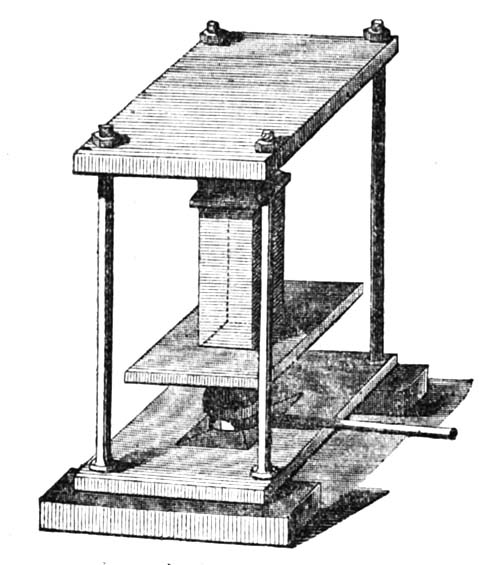
It is next delivered to the mill for grinding, and after being sifted is packed for use, the important points of uniformity in colour and in time of setting having been previously ascertained by repeated experiments. Daily trials of the strength of the cement are made by moulding it into bricks (vide Appendix, Experiments on Cohesion, Fig. 3), which in twenty-four hours after setting, are exposed to rupture by extension, in order to prove the cohesive power.
This is the mode adopted by the French Engineers for testing the quality of the cement employed in the Government works.
The progressive increase in the strength of the cement is quite remarkable. In seven days, it attains a cohesive power of more than 100 lb per square inch, and at the end of three months, these bricks will require more than 2,000 lb to break them, a strength equivalent to 414 lb per square inch; as in the case of one, made of Portland Cement of ordinary quality, broken at the Exhibition in September, 1851 (vide Appendix). Another plan adopted in France of testing the hardness of cement, is by means of a machine fitted with a pointed rod, which being allowed to descend with force upon the specimen of cement placed beneath it, determines by its degree of penetration, the extent to which the material has indurated. The amount of this penetration is expressed by a graduated scale on the upright rod of the machine (Note A04).
Though too minute to be employed in testing large deliveries of cement, it is nevertheless useful for determining the setting power, particularly under water. A sketch and description of this instrument is given in M. Vicat's work on Cement (Note 3).
The numerous operations involved in the production of Portland Cement sufficiently distinguish it from the natural cements, the manufacture of which consists in burning the stone in open kilns, to the extent needed to deprive it of its carbonic acid gas; in grinding, and afterwards filling it, as delivered from the mill, into packages for use, a simple and economical operation. To the variety then of the processes, to the extra fuel employed, and to the time and care expended upon the manufacture, the cost of Portland Cement is attributable, and not to the materials of which it is composed, which in themselves are simple and inexpensive.
In an interesting communication lately made by M. Vicat in the Annales des Ponts et Chaussées, there occur some important observations on the mixture of cement with lime mortar, coupled with an investigation of the properties of cement burnt, as he terms it, jusqu’à ramollissement, by which is doubtless intended the softening, or melting, which takes place when the clay begins to vitrify. In his first experiments on the blending of the natural cements with the artificial hydraulic limes, M. Vicat mixed the cement with the lime during the process of manufacture, while it was in a state of paste, but he found that the tardiness of the operation needed for the production of the mixtures, entirely deprived the cement of the energy of its first setting, which coupled with the expense of the compound, induced him to relinquish the plan. Facts that subsequently came to his knowledge, caused him to resume the study of the subject, and he found that by adding cement to the lime, when in a state of mortar, and not during the process of manufacture, the energetic properties of the cement were not interfered with, and that the mortar so treated, possessed remarkable powers of resistance to the action of sea-water.
An important fact developed during these investigations was that the stalest cements impart the most hydraulic properties to the lime; a circumstance to be accounted for, perhaps, on the principle that the lime in the cement, having parted with its energetic properties, by the absorption of moisture from the atmosphere, and the alumina being then the predominant element, the stale cement acts the part of Pozzolano, and imparts the hydraulic character to the lime mortar with which it is mixed. The experiments made on blocks of béton formed of this cement mortar, show that by the mixture of 6 parts of lime to 10 parts of cement, a cohesive power equal to that of the best natural hydraulic limes is given; while a less proportion of lime, say from 1 to 5 parts mixed with 10 parts of cement, only produces the same effect as the Pozzolanic mixtures—the addition of the cement causing an extra cost of about 50% per yard cube of mortar.
It must be noticed in the experiments detailed by M. Vicat, that the blending of fresh cement with the lime was attended with only partial success, for a mixture made of 10 parts of cement and 8 parts of lime, and which occupied sixteen days in setting, could be pierced by the drill to the depth of one-fourth of an inch, and after immersion during eleven months it lost superficially all consistence, and was penetrable nearly three-eighths of an inch before arriving at the quick; which shows that deterioration took place after setting, and brings in question the expediency of mixing lime with fresh cement in important hydraulic works.
The same proportion of stale cement mixed with lime, set in two days, and showed a resistance to the drill, just four times in excess of that offered by the mixture made of lime and fresh cement. The mortar made with stale cement and lime has the farther advantage of speedily becoming very hard on the surface, and thus covers itself with a crust sufficient to oppose the shock of the waves and the rolling of the shingle; thus allowing the interior to attain a proper amount of cohesion, and to arrive progressively at its ultimate degree of hardness. It is, however, obvious that the cases in which the cement would require through staleness (i.e. from the re-absorption of carbonic acid, or moisture from the atmosphere) to be re-invigorated by the addition of lime, are in this country at least, of infrequent occurrence, and since it is not contended that these mixtures furnish results which can be put in comparison with those of the cements themselves, it is only in such instances as the exportation of cement to distant countries, where the interval between its manufacture and its use, has been so considerable as to occasion staleness, that such a practice could be recommended for adoption. In the before-mentioned communication of M. Vicat in the Annales des Ponts et Chaussées, there occur some observations on what he terms Ciments brulés, as opposed to the Ciments cuits, in which he notices especially the Portland Cement. He says:—" The setting action of these cements is variable—in some cases being accomplished in an hour—in others only after an interval of weeks”. The difficulty of grinding them and the quantity of fuel required in their calcination are, in his judgment, insuperable obstacles to their adoption, but he states that if their property of progressive hardening and their cohesive powers be examined, they will be found quite remarkable, and greatly in excess of the best natural hydraulic limes—200 lb per square inch being the greatest resistance to compression, eventually attainable by the limes, while these highly-calcined cements acquire that hardness in a few days, and will at last reach 700 lb per square inch, a resistance superior to that of the calcareous lithographic limestones.
Two volumes of sand reduce this resistance to about 350 lb per square inch, or one-half; but it is not the less true that these cements resolve the problem of producing an artificial stone that shall be equal in hardness and density to compact limestones.
As a matter of comparison it may be noted that the eventual resistance to compression of Portland Cement is, when used pure, 2,000 lb per square inch—with two volumes of sand it is 1,250 lb, and as a concrete stone it is about 1,750 lb per square inch —forces greatly in excess of M. Vicat's trials.
Of the Portland Cement, M. Vicat observes that it possesses all the properties of the over-burnt cements, with a moderately quick-setting power, that its density is 1.50, the density of ordinary cements being taken at 1.00, and that its chemical analysis is precisely that of a very eminently hydraulic lime. "The most noticeable fact," he says, " in these cements, is their great hardness and the resistance they consequently offer to the combined action of the sea and shingle in the most exposed situations, agencies which very speedily destroy the Pozzolanic mixtures and the best hydraulic limes. . . . . By these alone it is possible to effect the monolithism of great masses, entirely homogeneous and resistant in all their parts, and arriving after a few months, at the hardness of compact calcareous stones. To attain this object, it is indispensable to employ the slow-setting cements, which will allow of tomorrow's work following upon that of today without disconnection, or break—a result which it is impossible to arrive at with the ordinary quick-setting cements”.
The agency to which cements owe their power of setting, and consequent induration, is not generally well understood. It has been commonly considered that this action is due to absorption by the cement, of carbonic acid gas from the atmosphere, during the process of setting; but it seems now to be ascertained by chemists that it is only partially to this cause that the hardening of cements is attributable; that it is in fact, the chemical union of the lime with silica and clay, and the consequent formation of a double silicate of lime and alumina (Note A05) that produces the effect, without which, cements placed in positions where air cannot penetrate, would never harden. It is, however, well known that cements used under water, become as compact as when exposed to the air, and that in the interior of large concrete blocks, the process of induration is not less complete than it is on the outside, making due allowance for the increased hardness imparted to the surface of the block by the action of the atmosphere, which, however, is only superficial in its effects.
With lime the case is different. In its pure state, unmixed with clay, lime hardens solely by the absorption of carbonic acid from the atmosphere, and is thus partially re-converted into its original condition of carbonate of lime, but inasmuch as the quantity of this gas contained in the atmosphere is limited, the operation of it upon limes is slow and feeble, hence the proverb that "lime at a hundred years is a child" (Note A06); and hence also the fact familiar to all, that the rich limes used as mortars in the hearting of very thick walls, do not harden, even after the lapse of many years. It will thus be seen that for the hardening of the rich limes, the presence of air, and consequently carbonic acid, is essential, while for the water-limes in which clay exists in small proportions, and for the hydraulic cements into whose composition it largely enters, the influence of this gas is comparatively unimportant, nature having afforded another and more efficient means for the completion of the hardening process. The peculiar affinity of the lime for the alumina and silica, appears to be exerted most powerfully with those cements, whether natural or artificial, which are most highly calcined, and consequently, set the slowest. To this cause then, must be referred the excellence of the artificially-produced Portland Cement. The proportions in which the ingredients are mixed, favour a high degree of calcination; slow setting is the consequence, and the final result is a degree of hardness superior to many kinds of stone. The slowness of its setting may prevent the employment of this cement for masonry set in water (particularly running water) except in a pure state, which increases the cost; but it is not the less true that the tardiness of its action, insures for the work executed with it, a degree of ultimate solidity, so superior to that produced by the quick-setting cements, as to more than compensate for what would, at first sight, appear to be a disadvantage.
The uses of Portland Cement in the several applications of concrete, mortar, and stucco, are extremely various. The use of concrete made of lime, in those positions where heavy super-structures demand a more efficient base for their support, than is afforded by the soil alone, has become so common, and its application is so generally attended with success that it will be needless to notice here more than one form of its employment-that of concrete blocks, a mode of constructing great masses which recommends itself equally on the score of economy and simplicity.
To Mr Ranger (Note A07) is due the credit of having first attempted in this country on any considerable scale, this method of construction in important works. The blocks he used were composed of lime, sand, and gravel in due proportions, and no pains were spared to insure the rapid setting of the lime, as well as the perfect incorporation of the materials. They were not, however, found capable of resisting frost, and the action of heavy bodies striking against them, and, though disintegration of the parts did not ensue, to the same extent as in the blocks at the French ports, already referred to, the failure was sufficiently marked to prevent any further adoption of the plan, and was naturally calculated to produce in the minds of Engineers, a prejudice against the use of concrete for such purposes, which it has required time and further experience to dispel.
The large proportion of sand and gravel that can be mixed with Portland Cement without materially affecting its cohesive power, gives it an immense advantage over lime, which though cheaper in first cost, cannot be safely mixed with much more than seven times its volume of foreign matter.
While it is not disputed that if sufficient time be allowed for their induration, blocks made of lime and Pozzolano will, in time, attain a cohesion quite sufficient for the interior parts of breakwaters, or dock walls, it is emphatically by the substitution of Portland Cement in place of lime that such an entire consolidation of the several materials can be effected, as shall set at defiance the action of frost and the force of the waves, and by thus realizing the perfect homogeneity of great masses, re-establish the confidence in such constructions which previous experiments had tended much to weaken.
Some account of the employment of Portland Cement for concrete blocks, in the Government works of this country and of France, will afford the best criterion of its adaptation for such purposes.
At the Government harbour of refuge works at Dover, under the superintendence of Messrs Walker and Burges (Note A08), these blocks are extensively used for that part of the hearting of the breakwater, which being under low-water mark, cannot be filled in with concrete en masse. The cubic contents of these blocks vary from 45 feet to 120 feet, and the weights from 3 tons to 7 tons; the dimensions of width and depth being generally equal, and the length about twice the width. The composition and the mode of construction are very simple.
One cubic foot of cement, measured dry, is mixed with 10 to 11 cubic feet of shingle from the beach (consisting of large and small clean shingle and coarse sand in nearly equal proportions) in a box holding as much material as will form one block, the cement and shingle being spread in alternate layers until the box is full. One side of the box being then withdrawn, the contents are allowed to fall gradually on to the mixing platform, where water is added, and the concrete is made, which is then shovelled into moulds of the required size, in which it is allowed to remain about twenty-four hours, until it is sufficiently set to permit the sides of the mould to be removed. The blocks so made then stand for eight or ten days, and are then conveyed either into their positions in the work, or are, more usually, piled up for stock. The holes for the lewises (Note A09) penetrate two-thirds of the entire depth of the block, and are formed during the filling process, by inserting. bevelled wooden plugs, which are withdrawn when the block is hard. The labour attendant on cutting the lewis holes, as in stone blocks, is thereby saved, and the risk of fracture is also diminished by the precaution of forming the holes nearly, if not quite through the block. It will, however, give some idea of the cohesive power of the concrete to state that on the tenth day after being made, blocks of 3 and 4 tons weight have been lifted by lewises sunk only 8 inches into the mass.
The large blocks of 112 cubic feet when moulded contain about 13 cubic feet of dry cement and 136 cubic feet of dry shingle-total 149 cubic feet-a proportion of about one in eleven, showing a diminution of bulk of about 25%, by the agglomeration of the materials, in the transition from the dry state to that of concrete.
The great hardness and cohesive power of these blocks, and the success which has attended their manufacture (scarcely 1% of the whole number made having been broken) show this to be a suitable proportion for the blending of the materials.
At the harbour of refuge works of Alderney, under the direction of the same Engineers, a similar application of concrete blocks is made as at Dover, with this difference, that in their manufacture, rubble-stone, which is very abundant in the island, is mixed with the shingle.
The proportions adopted are, one part of cement, two parts of sharp sand, and four parts of coarse and fine shingle; these materials, converted into concrete and thrown into the moulds, in quantities of 8 or 10 bushels at one time, suffice to form a layer over the whole surface of the mould. Flat pieces of rubble-stone, varying in size from 3 inches to 20 inches in length, are then imbedded promiscuously in the concrete, and this operation is repeated till the mould is filled. The quantity of stone thus incorporated in the block, is found to constitute about 40% of the whole bulk, and the proportion of cement to the mass is one in ten, as at Dover (Note 4). Lewis-holes are formed as the work proceeds, and these blocks, like those made at Dover, are ready for moving in about ten days. They contain from 60 to 100 cubic feet, and their weight is from 4 to 6 tons, reckoning 16 cubic feet to one ton. The degree of smoothness and external finish given to the blocks, depends chiefly upon the quantity of water used in mixing the concrete. If gauged soft, the cement will find its way to the sides and surface, and will give an even face to the concrete, which in time becomes intensely hard, and as serving to protect the interior from the action of the sea, when the blocks are used in external walls, it is perhaps preferable to leaving them with a rough and honeycombed face, the result of using but little water in mixing the concrete. It is not, however, found needful to observe this precaution at Dover and Alderney, since at both places, the blocks are used exclusively for the hearting, or for the foundations of the walls, and are consequently not in permanent contact with the sea and the shingle. The blocks are set by the diving-bell at Dover, and by men in diving-dresses at Alderney, and are bedded dry, their close contact with each other, and their position in the wall, rendering the use of cement un-necessary, except to point the joints externally as the work proceeds.
The blocks made at the important works of the Digue (Note A10) at Cherbourg, where Portland Cement is largely used, are of enormous size, and are made in a different manner to that adopted either at Dover, or at Alderney. The dimensions of those made at Cherbourg, are 12 feet long, 9 feet wide and 6 feet 6 inches deep, giving a cube of 712 feet, or 52 tons. These masses are constructed like rubble masonry without moulds, and are built up at low-water in a position convenient to the work. When made, they are slung to pontoons and floated at high-water to the point where it is desired to sink them, and then deposited à blocs perdus at the extremities of the Digue, near to the upright wall, in order of break the force of the waves at its foot and to prevent the disruption of the masonry. The object of making blocks of such immense size, is to secure their remaining permanently where they are deposited, the calculation being that the waves would not have power to move masses exceeding 20 tons in weight. It has not, however, been found that even these immense monoliths can always resist the motive power of the waves, for on more than one occasion, they have been thrown up whole and unbroken from the bottom to the top of the breakwater wall, a height at least of 30 feet. The mortar used in the construction of these blocks, consists of one part of Portland Cement to three of sand, which materials unitedly occupy from 30 to 40% by measure, of the whole mass.
In the communication before referred to, M. Vicat draws some conclusions with respect to these masses. He states that after testing the relative strengths of the blocks made at different places, e. g. Fort Boyard (Charente Inférieure), at Marseilles, at Algiers, &c., he finds that the mean cohesion of a mass of concrete launched into the sea from the land, must be about 60 lb per inch square, and that if deposited by sea, it must be from 40 lb to 45 lb per inch square, while it must have a cohesion of 25 lb per square inch, to resist simply the shock of the waves, when it is once in position, and in a state of unyielding solidity. It must not be inferred, however, that the long-continued action of marine forces during a course of years, will not affect masses having these degrees of cohesion; on the contrary, "Granite itself yields to their influence. Art can do little against time. Its mission is to construct and keep up works for a certain period, the measure of the efforts to be employed in so doing, being regulated by the joint considerations of economy and the intended limit of this duration."
"It has been found that the strongest impulsive force that the waves can exercise, over a surface of a metre square (an area equivalent to nearly 11 feet English) is 30,000 kilogrammes or 30 tons, equal to 40 lb per square inch of compressive force, and answering to 9 lb on an average of resistance to tension for the same unity of surface". In comparison with these data, may be noticed the results afforded by concrete stone blocks of Portland Cement. Their interior cohesion becomes, in the end, very considerable, and exposed to crushing by hydraulic pressure, these blocks show, after nine months, a resistance of 113 tons per square foot, or more than 1,700 lb per square inch, which is but little inferior to Portland stone, while their power to resist tension is 200 lb on the superficial inch.
Another method adopted in this country, of forming concrete stone blocks, is to mix the cement with the stone in a state of grout. The stone is placed promiscuously in the moulds, and when one-third full, the grout, composed of one part cement and three parts sand, is poured in till the interstices are thoroughly filled up. It is true that blocks so made require longer time for induration than those made with cement stiffly gauged, but their ultimate solidity and the thorough homogeneity of the mass, is evidenced by a specimen sawn from the heart of a block made of grouted cement and Kentish rag-stone, which has in twelve months, acquired such hardness that the cement is scarcely distinguishable from the stone to which it adheres. In situations where gravel is scarce, and where time can be given for the induration of the blocks, this mode may be adopted with advantage.
It is very questionable if sufficient importance is attached to the principle of ramming concrete, whether used en masse, or formed into blocks. To adopt that process with a quick-setting cement, mingled with only twice its bulk of sand, is to destroy the setting, or crystallizing action of the cement and to render it valueless, but in the case of lime, or Portland Cement, where the mixture of foreign matters is very large and the process of setting is slow, no such result takes place, and it is submitted that the practice of consolidating the concrete by beating, immediately on its being deposited in place, would tend greatly to increase the density and solidity of the mass, which effect is further aided by the diminished quantity of water employed in mixing.
The best practical exemplification that can be given of this opinion is the material called “Artificial Granite”. It consists of Portland Cement driven into intimate contact in iron moulds with fragments of Portland stone, by sharp and often-repeated blows, and the union of the two materials is the more remarkable, because it can be effected almost in a dry state, and with scarcely more water than is given out by the stone in the process of concussion. The uses of such a material, which is made to take any shape according to the moulds employed, are obvious:—pipes, sewer-blocks, landings, pavements, and even walls, are some of the applications which have been made of it by the inventor, who has found its duration as a pavement, in some very exposed situations, superior to that of Yorkshire stone.
The extremely close adhesion of this cement, under all circumstances, to Portland stone, gives rise to the speculation whether, or not any chemical action is exerted upon the cement by the stone, which is a pure carbonate of lime. The absorbent properties of the stone are doubtless a mechanical means of producing close contact, between the two bodies; but it is also possible (Note A11) that a certain quantity of carbonic acid is given out by the stone and absorbed by the cement, which is thus more speedily carbonated than it would be, if it were placed in contact with siliceous bodies, such as flint pebbles, round which, as nuclei, the cement crystallises, by the mere force of molecular attraction.
A corroborative proof that some such action takes place with limestones, is that sandstones, though equally absorbent, develop properties of adhesion to the cement, far inferior to those of Portland stone.
Mr Burnell (Note A12), in his excellent treatise on Cements and Limes, hints at the possible affinity of these substances for the limestones. In page 77 of his work, is the following passage (Note 5):—
“Broken limestone appears to add very much to the qualities of concretes, bétons, and mortars. Very probably this may be attributed to the affinity between the molecules of the already-formed carbonate of lime, and that which is in process of formation; the new crystals may group themselves more easily about bodies whose form is similar to the one they are to assume. Or possibly there may be a tendency in the chemical elements to arrive at a state of equilibrium; and the carbonate of lime may, therefore, be supposed to part with a certain portion of its carbonic acid gas".
The experiments made on the adhesion both of Portland and Roman Cements to various stones, and which form an Appendix to this Paper, tend to prove that their adhesiveness is greater to Portland than to any other description of stone.
The average of these trials shows that a force of 5,276 lb or nearly 26 tons, was required to tear asunder two blocks of 6 inches cube (vide Appendix, Fig. 2), jointed with Portland Cement—being 146 lb per square inch of sectional area; while with granite, Bramley Fall (Note A13), and Whitby stone, the resistance was but 97 lb, 76 lb and 57 lb respectively, on the square inch. On reference to these experiments, it will be observed that the joint between the cubes of stone was barely one-eighth of an inch in thickness, and that the stone was broken before the separation of the joint could be effected; and the results further show that the connecting power of Portland Cement is, compared with Roman Cement, as 35 to 1. The following is a resume of the trials by compression, made on blocks 9 inches square and 18 inches long, the pressure being exerted on the ends of the blocks.
- Roman cement and two parts sand bore 5.33 tons per square foot
- Portland cement and three parts sand bore 44.00 tons
- Roman cement, pure bore 50.00 tons
- Portland cement and two parts sand 80.00 tons
- Portland cement, pure 146.00 tons
The relative order of strength of the different mixtures is exhibited in this table, and as a matter of comparison:
- Portland cement pure is 3 times the strength of pure Roman cement.
- Portland cement and two parts sand are 1½ times the strength of pure Roman cement.
- Portland cement and three parts sand are equal to pure Roman cement.
The experiments on cross-strain tried at the Great Exhibition, give the following order of resistance. They were made on beams of pure cement, supported at both ends, and loaded in the centre, 4 inches in depth by 4 inches thick, with a clear bearing of 16 inches.
- Portland cement, pure, 99 lb per square inch
- Portland stone, 80 lb per square inch
- Sheppy cement, 61 lb per square inch
- Harwich ditto, 24 lb per square inch
The Brick Beam, erected at the Exhibition Building, was constructed for the purpose of testing the comparative strength of Portland and Roman Cement, in the direction of the cross-strain, and of showing the adhesiveness of Portland Cement to bricks. It was built at the Great Exhibition Building, in Hyde Park, and was broken down in the presence of the Jurors of Class 27 (Note A14), and of numerous scientific and professional gentlemen.
(There follows the description of the demonstration masonry beams, which I skip over.)
Returning to practical usage, the paper went on:
Of Portland Cement as mortar.- The adhesive quality of this cement to bricks, is seen by the foregoing experiment, to be of an intimate nature. The mixture of four parts of sand with one part of cement, forms a mortar which may be relied on in ordinary work, and is the proportion which has been used for some years at the Houses of Parliament. In arches, or other work, where rapid consolidation is required, less sand will of course be used; but where time is not an object, there seems hardly any limit to the quantity of sand which the cement will carry, provided only the grit be sharp and clean.
In testing the resistance to compression, of brick piers built with cement, the average resistance is found to be about 38 tons per square foot, but as Roman Cement is nearly always, and Portland Cement invariably, stronger than ordinary bricks, it is not in these experiments that the peculiar properties of the cement are developed.
It only remains to mention the application of Portland Cement as a stucco. Its agreeable colour, which is susceptible of further improvement by the addition of any light stone dust, or of white sand, joined to the peculiar property it possesses, of resisting frost and the formation of vegetation, recommends it as an external covering. This power of resisting frost and the humidity of the atmosphere, arises from the close contact of the particles, which, producing a non-absorbent surface and thus preventing the disintegration common to cements of less density, renders it a peculiarly suitable material for lining reservoirs, cisterns, baths, &c., and has also caused its extensive adoption for the casting of ornamental figures, statues, fountains, &c., thus combining the appearance and durability of stone, with the economy resulting from the use of the mould, rather than of the chisel, which, if not the most legitimate application of cement, is one which, by its increasing demand for objects of art at a minimum cost, has been largely sanctioned and encouraged.
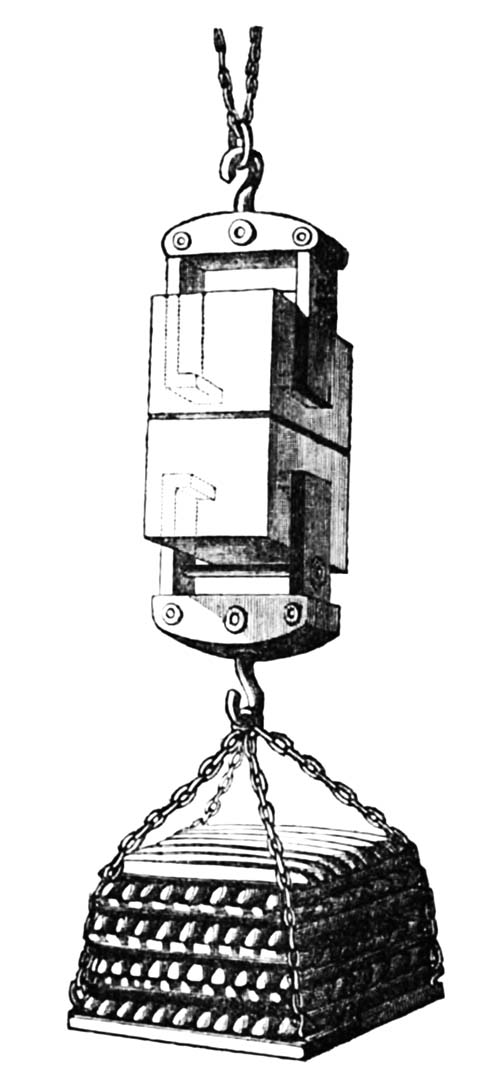
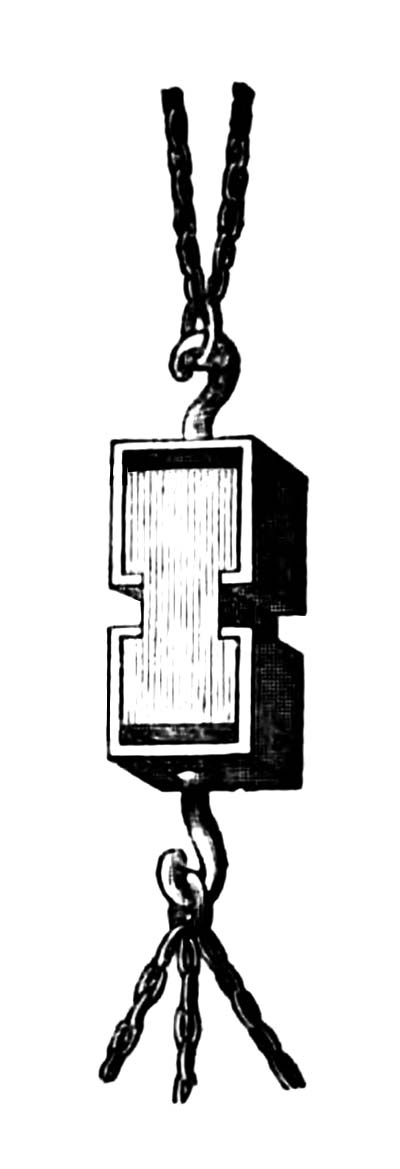
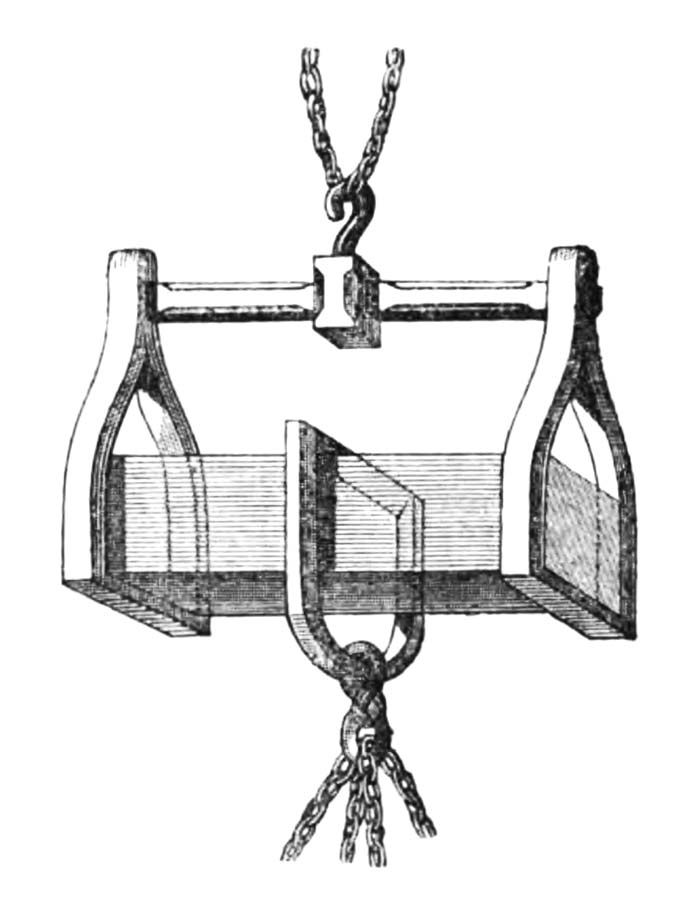
he Paper is illustrated by a series of Diagrams, from which Plate 5, and the Woodcuts, figs. 1 to 4 (vide Appendix) are compiled.
Discussion
Lieutenant-General Sir Charles Pasley said that in 1826, when practical architecture constituted a part of the studies of the young Engineer Officers at Chatham, his attention was drawn to this subject. At that period, the most contrary opinions were advanced with respect to hydraulic limes, and the only satisfactory observations were those made by Smeaton at the Edystone Lighthouse. He was then induced to experiment upon artificial cements: he tried various proportions of chalk and clay, but failed in consequence of his not being accustomed to chemical manipulation. In 1828, he was requested by Colonel Reid to repeat those experiments, and by accidentally combining the chalk with the alluvial mud of the Medway, he produced, to his great surprise, a cement, which subsequent experiments brought to considerable perfection, and of which, in 1830, he printed a description for private circulation. In the same year, Mr Frost, who entertained M. Vicat's opinions of the superiority of blue lias lime, and who then had the manufactory at Swanscombe, now in possession of Messrs White and Sons, was induced, by his recommendation, to adopt the new process. In 1837, he pointed out to Mr White the causes of failure of some cement, and that gentleman expressed a doubt, whether any that was made artificially, could ever equal the natural cements, but General Pasley proved, on the contrary, that it was stronger than the best Roman Cement. His process was used in the preparation of Greaves' blue lias cement, a fact of which he was not aware till the year 1844, when he happened to be inspecting a branch of the London and North-Western Railway, where it had been employed. In 1845, the lithic cement was used at Manchester by Messrs Evans and Nicholson, and it was said to be the produce of chemical works. On examination, it turned out, that the same proportions of lime and clay were employed as in his process, and that the addition of the refuse of the chemical works, in nowise altered, or improved the material. The cement exhibited by Messrs Robins and Aspdin also appeared to be very good (Note A15).
The comparative trial mentioned in the Paper, would, he thought, have been more conclusive, if the beams had been similar in both cases, and it must be remembered that no experiments with Roman Cement could be relied on, unless its age were correctly ascertained. His object had been to produce a cement resembling what was called Roman Cement, and he congratulated himself that his endeavours had led to the introduction of a cheaper and better quality, and that by its adoption in France, the theory of M. Vicat had been practically refuted. Another great advantage attending the process, was the improvement in the navigation of the Medway, by the constant removal of deposit from the bottom. Mr White's practice surprised him in one respect, that strong cement should bear a greater proportion of sand than lime, nor could he understand the statement in the Paper, that in order to make good concrete, cement should set slowly. There was no particular aptitude in cement to adhere to one kind of stone more than another; it made, indeed, little difference whether the stones were polished, or not. The largest masses of masonry might be put together either by artificial, or natural cement, and had Smeaton been aware of this fact, it would have saved him the trouble of dovetailing the stones, in the construction of the Edystone Lighthouse.
Mr Hawkshaw (Note A16) was of opinion that the hoop-iron in the beams destroyed the value of the experiments, as a great proportion of the resistance would be due to the iron, and as it was not similarly disposed in both cases, no conclusion could be drawn as to the relative strength either of the beams, or of the cement. He did not understand the division of cements, into natural and artificial; all those used by Engineers and Architects were artificial cements. The force required to crush compact limestone, was very much greater than 700 lb per square inch, accorded to it by Vicat.
Mr White explained that the term "natural" cement was applied to the material manufactured from the argillo-calcareous nodules, known as cement stone, and found abundantly in England; while the “artificial” cements were composed of the separate substances, lime and alumina (Note A03), combined in any given proportions, according to the will of the operator.
Mr Gibbs said that no analogy could be established between the two beams, for hollow bricks allowed the carbonic acid to penetrate in a very short time, whereas solid masonry could not set so quickly. He thought that the bridge at Maidenhead would not have exhibited any symptoms of subsidence (Note A17), if it had been constructed of hollow bricks, but the masonry being solid, sufficient time was not allowed for its setting before striking the centres. The quality of the Portland Cement appeared to be excellent, and it was evidently a great improvement on the others.
Mr Gravatt (Note A18) thought that no satisfactory conclusions could be drawn from the experiments, as there were three elements to be taken into consideration:- the hollow bricks, the iron, and the cement. The adhesion of cement to stone was, in a great measure, independent of the fineness of the surface, but when applied to bricks, they should be clean and damp, for any sand between them would be like so much dry glue. There was as much difference between cementing hollow bricks, and cementing stock bricks, as in glueing together pieces of steel, or pieces of wood. The real test of the strength of a cement, was to attach the bricks together one under the other, and to suspend the whole perpendicularly. During the construction of the Thames Tunnel, sometimes as many as four hundred experiments were made in a week, every cask being tested. The brickwork was built in equal parts of Roman Cement and sand; it was perfectly hard at the end of a week; after six months, it became much softer, but at the end of a year, it recovered its former hardness. The middle pier was first constructed solid, and the side arches were cut through after an interval of about six months, as it would have been very difficult to have done so either before, or afterwards.
Mr J D Hopkins (Note A19) observed that it was very unfortunate for the success of the experiments that the bricks were not of the same description in the two beams ; there were many disadvantages in the mode adopted of bonding the hollow bricks. He did not think that the different position of the hoop-iron had greatly influenced the results, it only amounted, in both cases, to a bar, 1¼ inch by 1 inch.
Mr J Locke, MP, VP, (Note A20) thought the objections which had been made, were well founded. There was no doubt that the different distribution of the iron altered the composition of the beams, and that the hollow bricks, by allowing the admission of the air, materially affected the result in that particular case. But the most important object of the Paper, was to advocate the employment of good cement in the construction of hydraulic works. He was both surprised and pleased at the account given in the Paper, of the employment of this cement at the Digue of Cherbourg, and of the enormous masses there created by its help. Such a material could not fail to be most useful in hydraulic works. Greater experience was continually changing the views of Engineers, and had this cement existed in the days of Smeaton, it would, no doubt, have caused an alteration in his practice. Mr Hartley of Liverpool, whose vast experience was well known, was now using common rubble with good cement, instead of constructing the quay walls as formerly, in solid ashlar, and the expense was thus considerably reduced.
Mr Francis (Note A21) must add a few words in favour of Medina Roman Cement, with which, during the last fifty years, the most important works in this country had been executed. It had been employed in the construction of the Thames Tunnel, in the foundations of the centre pier of the Britannia Bridge, in the works at Cherbourg, the harbours of refuge at Dover and Alderney, &c. At the Isle of Wight, a retaining sea groyne, 200 feet in length, had been con-structed with a remarkably small quantity of Medina Roman Cement and sea-beach; and it had for the last four years, withstood the violence of the sea. The great value of this cement consisted in its proper quality of setting quickly.
Captain Fitzroy, RN (Note A22) thought that some light might be thrown on the nature of cement, by the use of the microscope and goniometer, which had elucidated several points in Geology. The mechanical arrangement of the particles might thus be ascertained, and also whether they assumed crystalline forms, or whether they had undergone some chemical, or magnetic change. In the South Sea Islands, very large statues had been found, evidently formed of an artificial substance, of which it would be highly interesting to obtain an exact analysis. Old cements might be usefully submitted to a similar examination, also specimens of old moles and of other works of the ancients, which might prove to be artificial.
Mr White, while admitting that it would have rendered the comparison easier, if the beam tested at the Exhibition had been constructed like the other, of solid bricks, thought there was less importance to be attached to the presence of the hoop-iron in the beams, than had been supposed, since its collective amount was only equivalent to a bar of l¼ inch by 1 inch, and a certain portion of the iron was, by mistake, disposed above the line of the neutral axis and became, therefore, practically useless.
Neither did he consider that the loss in solid content, resulting from the use of hollow bricks, was compensated for by the introduction of air through the interstices, which, it had been argued, would tend to harden the cement quickly. It was to be remembered that the setting action of cement was not due, as in the case of mortar, to carbonization by the atmosphere, but to the chemical formation of a double silicate of lime and alumina, acting alike on every part of the cemented mass. The quantity of carbonic acid in the atmosphere was small, and its action was powerless, except on the outer crust of the cement, which it penetrated to the extent only of 1-32nd of an inch. This penetration was rendered apparent by a change in the colour of the cement, and its influence was most felt on soft and porous cements. He considered, therefore, that, in the Maidenhead bridge, the use of hollow bricks could only have prevented failure, by their weight being less, or the load being differently distributed, and not by the opportunity they would have afforded for a speedier induration of the cement.
The hardening process with all cement was a gradual one, and was to be distinguished from the setting process which might be considered immediate. As a rule, the natural cements were quick setting. Cement might set too quickly, from its being underburnt, or ill prepared, in which case, it would, in the language of the work-men, “give again”, and become soft after working. This change was rapid, and when once effected, the cement would never thoroughly harden, though it would dry in time. It was quite contrary to his experience that cement should harden at first become soft in six months, and harden again in an interval of twelve months (Note A23). This was not the characteristic of good cement, and if the observations had been properly made, it could only be supposed that the material was defective in the first instance.
The experiments and suggestions of Sir Charles Pasley had been very serviceable in drawing attention to the use of artificial cements in this country, but at the same time, it should be understood that the cements made by General Pasley, or by Mr Frost, were not identical with the material now known as Portland Cement. The constituents of the three cements were however similar, and they differed but little in the proportions employed but both Sir Charles Pasley and Mr Frost stopped short at the all-important point of calcination, and they rejected that part of the kiln as overburnt, which was now found to yield the most valuable product. The aim of Sir Charles Pasley had been to rival the natural cement, and he had succeeded; but it had been reserved for another operator to produce in Portland Cement, a material which should far outstrip in cohesive power, any of the natural cements known in this country.
Mr White found it difficult to concur in the opinion that the introduction into France of this artificial cement, was a refutation of M. Vicat's theory as to limes and cements. That M. Vicat had a preference for the employment of limes, was undoubted, but not to the exclusion either of natural, or artificial cements. His labours, in fact, had been directed like those of General Pasley to the production of an artificial compound which, in setting slowly and attaining great eventual hardness, should combine the properties both of a lime and a cement; and his researches as published from time to time in the Annales des Ponts et Chaussées, were alike honourable to himself and beneficial to science. M. Vicat was ever ready to appreciate the labours of others, and that he recognised peculiar properties in the Portland Cement and valued it accordingly, was shown by the desire he had lately expressed, to be furnished by Messrs White with all the particulars of its fabrication.
Allusion had been made to a cement manufactured at Manchester, called lithic cement. Its components were lime and clay, as in other cements, but to these was superadded the chromate of iron, a chemical residue which increased the hardness of the cement, but gave it, at the same time, so unpleasant a colour that it could only be used for brickwork and not for plastering purposes. Much of the clay used in the manufacture of Portland Cement, was impregnated with iron, a disadvantage rather than otherwise, since the percentage was too feeble to materially augment the strength, while the colour it imparted, interfered with the grey tone so much esteemed in that cement. Cements that did not contain a large proportion of lime, like Portland Cement, were undesirable for concrete; hence ordinary Roman Cement was not employed for that purpose. It was essential to its eventual hardness that concrete should set slowly, and the opportunity was thereby afforded of punning the concrete, whether used en masse, or in moulds; but it was important not to disturb the crystallization, when it had once commenced.
He differed with the opinion that had been expressed, that cement adhered with the same force to all stones alike and experiment had shown it to be erroneous. The porous nature of certain stones, such as the Portland and the Kentish rag, caused the cement to adhere to them as perfectly as to brick, whilst to the more intractable stones, such as granite and, the harder sandstones, the adhesion was remarkably slight. It should be borne in mind that the setting of cement was mechanically aided by the evaporation of the water used in mixing it. Any substance, therefore, like dry stone, or porous brick, that helped this absorption, was peculiarly congenial to the cement, while hard, or polished surfaces such as glass, or marble, were very imperfectly united by water cements, though they could be effectually joined by oil cements, or other substances, the operation of which was to effect union by the exclusion of the air. Upon the whole, he could not regret that the experiment had been made, as it exhibited hollow bricks in contrast with solid bricks in a position they bad not hitherto occupied, without suffering by the comparison. The adhesion of cement to the hollow bricks, was as perfect as it was to the solid bricks. If however, the brick beam was not to be regarded as a satisfactory test of the value of the cement, the experimental tables in the Appendix to the Paper might confidently be appealed to, exhibiting the cement under the action of pressure and of cross strain, as well as demonstrating its cohesive strength, and its power of connecting other bodies. Under all these conditions it exhibited a manifest superiority over ordinary Roman Cements, which though excellent of their kinds and useful, where quickness of setting was an object, were rapidly giving place to the stronger but more costly material known as Portland cement.
Mr White then called attention to a Paper on the subject of cements, contributed by Dr Schafhaeutl, of Munich, to the German Polytechnic Journal of November 1851, and since published by him in the form of a pamphlet. In bearing testimony to the general accuracy and importance of the statements contained in that Paper, and in expressing his admiration of the comprehensive view therein furnished of the history of cements in England, he could not refrain from noticing some remarks which reflected invidiously not only upon the cement-manufacturers of this country, but also on those who had occupied themselves with cements as a subject of scientific investigation. In a letter to Mr C Manby, the Secretary of the Institution of Civil Engineers, Dr Schafhaeutl complained that when in London, during the period of the Great Exhibition, though he had taken great pains to become acquainted with the nature and properties of Portland Cement, it was only with difficulty that he succeeded. Relying, however, upon the information obtained from a manufacturer of Roman Cement only, and on the published experiments of General Pasley upon artificial (but not on Portland) Cement, made fifteen, or twenty years ago, he impugned the correctness of trials made by Messrs White, and gave an opinion that the so-called Portland Cement was not superior to the well-known and long-tried Roman Cement. Now if an opportunity had been afforded, Messrs White could have adduced reasons for the superiority of Portland Cement, which had not even been hinted at by Dr Schafhaeutl's informant, and which were not to be found in the work of Sir C Pasley, who had never claimed for his artificial cement, a superior strength to that of the natural cements.
It was quite evident that Dr Schafhaeutl was unacquainted with a feature in the preparation of Portland Cement, which was, in fact, the distinguishing peculiarity of the material, viz., the degree of calcination employed in its manufacture, which by nearly approaching to vitrification, involved peculiar chemical changes and combinations, not shared by the natural cements when treated in a similar manner. Ignorant of this fact, he had attributed the superiority claimed for Portland Cement, to the presence of a larger percentage of natron, or soda, than was found in the natural cements, the difference, according to Dr Pettenhoffer, of Munich, being 2.00 of soda for Portland Cement (Note A24) and only 0.25 in the Bavarian cement. Now while it was granted that the combination of soda with silica, at a high temperature, would, if it existed in sufficient quantities, impart great hardness to the cement, it was by no means clear that soda uniformly existed in Portland Cement, in quantities sufficient to produce such an effect, for in other analyses made of this material, particularly that by M. Vicat, no trace of soda was found; hence the inference might be drawn that its peculiar characteristics were referable to other causes. In another part of his pamphlet, Dr Schafhaeutl expressed a doubt, whether the experiments made by Messrs White on Roman and Portland Cements, accurately exhibited the relative merits of the two materials, assigning as his reason, that being manufacturers of Portland Cement only, it was natural for them to depreciate the other. That suspicion would not however attach to them in this country, where it was known that they were equally interested in the production of both cements; and even if such were the case, there were statistics published by other Portland Cement manufacturers, which showed the experiments of Messrs White, to be under- rather than overstated. It was to be regretted that in a published document, quotations from other sources should be inaccurately made, but in the pamphlet in question, the adhesive force of Portland Cement to Bramley Fall stone was stated to be 36 lb to the square inch, while in fact, the result obtained, and from which the quotation was made, was 76 lb per square inch. To the assumption that English manufacturers owed the success of their cements to chance, while to the French and the Germans, exclusively belonged the merit of analytical investigation, there was the practical reply that Portland Cement was, at this time, being exported in large quantities, from England, both into France and Germany, and was eliciting from the Engineers of both those countries, the most flattering testimony of its superiority to any native production, either natural, or artificial.
Mr Rendel (Note A25), President, said that the introduction of these cements had, undoubtedly, caused Engineers to employ cut stone much less frequently. Mr Hartley, at the commencement of his career, thought it necessary, for insuring solidity, to use cut stone blocks of large size, where he now used rubble and cement. Time was a great element in the consideration of the choice of a cement; the cheapest was that which gave the requisite result the soonest. If plenty of time could be allowed for hardening, the blue lias lime would be the most economical; in the opposite case, the choice would lie between the Roman and the Portland Cements, the latter of which partook more of the character of a lias, whilst the former was useless, if once disturbed. If an Engineer desired merely to stop a hole, he would use Roman cement; but this was an exceptional case. He thought that each cement might find its peculiar application, and that experience would point out the circumstances for which each was more particularly adapted.
NOTES
Note 1. Vide Minutes of Proceedings Inst. C. E., I, 1838, p 16.
Note 2. Vide ibid p 20. Marc Brunel was still working on the completion of his Thames Tunnel at the time.
Note 3. Vide A Practical and Scientific Treatise on Calcareous Mortars and Cements, Artificial and Natural" &c. By L J Vicat, Translated by Capt. J T Smith, M.E., London, 1847, Plate 2.
Note 4. It is to be observed, however, that the introduction of rubble-stone, by confining the cement within a smaller compass, gives additional strength to the connecting material. Pro tanto, therefore, the rubble-blocks have a greater power of cohesion than those made of shingle, in which the cement is equally distributed through the entire mass.
Note 5. Vide Rudimentary Treatise on Limes, Cements, Mortars, Concretes, Mastics, Plastering, &c. By G R Burnell, CE, 8vo. London, 1850. Page 27.
Note A01. Marc Brunel’s Thames Tunnel was finally opened in 1843, and was constructed with Roman cement bonded brickwork. William Aspdin absurdly claimed that Portland cement had been used. The tunnel – one of the most celebrated constructions of the time – is still in use by the Windrush Line.
Note A02. White’s had continued to make and sell Frost’s British cement as a cheap but inferior alternative to Roman cement.
Note A03. The element aluminium was first isolated in minute quantities by Ørsted in 1825, but it was only produced at ingot-scale by Deville in 1854, so no-one in this audience would ever had seen it. Although Davy named it as an element as early as 1807, “alumina” or “alumine” remained for a long time a stylish catch-all for the mysterious unresolvable constituents of clay.
Note A04. This is the Vicat penetrometer, and is unique among the testing equipment mentioned here, in that it is still in universal use.
Note A05. This “double silicate” was proposed early in the history of Portland clinker as its active ingredient, without any good chemical justification. It was still being talked of well into the 20th century, although it was established by Le Châtelier in 1883 that alite is the characteristic phase in Portland clinker, and its hydration product is a hydrated silicate. However, the proposition that Portland cement strength development did not involve carbonation was correct.
Note A06. The old folk-saying actually referred to the tree rather than the mineral, but it still fits.
Note A07. William Ranger (1799-1863) was a civil engineer who in 1832 patented this concrete-making process. He used Dorking grey hydraulic lime.
Note A08. James Walker (1781-1862) and former pupil Alfred Burges (1796-1886) constructed the Dover Admiralty pier and harbour of refuge from 1847.
Note A09. A lewis is a self-locking bolt that fits into a dovetail-shaped cavity cut into the top of a masonry block, for lifting purposes. The cavities were much more easily formed by casting in concrete than by chiselling out from stone.
Note A10. Digue = dike = breakwater. This was the 3.64 km central stretch of the outer breakwater, complete with three forts, and massively larger than the other projects. It was completed in 1853.
Note A11. No, it’s not! The porosity and absorbency of all the stones mentioned is the key property. Porosity draws cement/water paste into the surface, increasing bond, and also withdraws water by capillary action, so reducing effective w/c ratio and increasing strength. Reaction between cement and aggregate is minimal, and in the case of limestones, non-existent.
Note A12. George Rowdon Burnell (1814-1868), Rudimentary treatise on limes, cements, mortars, concretes, mastics, plastering, etc., J Weale, 1850. He was a past student of Locke (Note A) and had long been working in France, but returned to England in 1848. Imbued with the doctrines of Vicat, he was no fan of Portland cement. He was both FRIBA and member of ICE.
Note A13. Bramley Fall stone is a Millstone Grit from near Leeds.
Note A14. Class 27 was “Manufactures in Mineral Substances used for building or decoration, as in Marble, Slate, Porphyries, Cements, Artificial Stones, etc.” The jurors were:
- Benedetto Pistrucci (Note A26), Chairman, Italy: Royal Mint: Her Majesty’s Chief Medallist
- Charles Hanbury-Tracy (Note A27), Deputy Chairman, 35 Dover Street
- David Thomas Ansted, FRS (Note A28), Reporter, 17 Manchester Street; Professor of Geology, King’s College
- Bernardo di Bernardis, Austria; 43 Clarges Street; Architect
- George Godwin, FRS, 24 Alexander Square, Brompton: Architect, editor of The Builder
- Charles Lemon, FRS, MP, 46 Charles Street
- Emmanuel Psycha, Greece; Civil Engineer, and late Professor of Physical Sciences
- Louis-Étienne Héricart de Thury, France; Académie des sciences
Associate Jurors were:
- Francis Barker, 71 Lower Grosvenor Street; gentleman of no profession
- Thomas Hetherington Henry, FRS, 18 Lincoln’s-Inn-Fields; Analytical Chemist
- George Lowe, CE, FRS, 39 Finsbury Circus; Engineer to Chartered Gas Company
Note A15. Pasley is here recalling, inaccurately, what he had written in his book. His is the only mention of Aspdin's cement, but he lumps it in with the other hydraulic limes he mentions, and appears not to have grasped the difference. In fact, he only became aware of Aspdin's cement when he saw his exhibit at the Exhibition.
Note A16. John Hawkshaw (9/4/1811-2/6/1891) was a civil engineer working mainly on railways, canals and harbours. After the death of James Walker, he completed the Dover harbour scheme. He became president of ICE 1862-1863.
Note A17. I K Brunel's Maidenhead railway bridge (1838) suffered a failure of its lowest brickwork courses due to premature removal of the staging. The brickwork was immediately remediated and the bridge still stands, carrying the London-Bristol railway, a Grade 1 listed building.
Note A18. William Gravatt (14/7/1806-30/5/1866) worked with Marc Brunel on the Thames Tunnel. Member of ICE from 1828.
Note A19. John Douglas Hopkins (4/1810-14/4/1870) was an artist, architect and one of the founders of RIBA. He collaborated with Henry Edward Kendall on one of the rejected designs for the Houses of Parliament.
Note A20. Joseph Locke (9/8/1805-18/9/1860) was Whig MP for Honiton and vice-president of ICE. He later became president 1858-1859. He was mainly concerned with railway construction.
Note A21. This is Charles Larkin Francis, who was just in the process of commencing Portland cement production at Vectis, having previously resisted it in favour Medina cement - his local variant of Roman cement.
Note A22. Robert Fitzroy (5/7/1805-30/4/1865) famously accompanied Charles Darwin on the voyage of the Beagle, and later developed the science of meteorology. Roggeveen (in 1722 the first European on Easter Island) suggested that the Moai were moulded from clay - a false idea that was still current. However, Fitzroy's suggestion that microscopy might settle the question of the "nature of cement" was correct, although two decades too early.
Note A23. White's dismissal of this expert observation is naive. Roman cement had two distinct stregth-growth mechanisms - an early fast growth associated with aluminate hydration, and a slow delayed growth associated with belite hydration. It is perfectly possible that in the variable ground-water conditions of the Thames Tunnel, the early stage hydration may have been disrupted by mid-term unsoundness, and re-healed by belite hydration. White would not have seen this in standard test conditions.
Note A24. Then, as now, sodium was very difficult to analyse.The 2% result was silly, and should be disregarded.
Note A25. James Meadows Rendel (1799-1856) was president of ICE 1851-1853. He built docks, harbours and bridges.
Note A26. Benedetto Pistrucci (29/5/1783–16/9/1855) had been employed by the Royal Mint as medal- and coin-engraver, but was by now retired. He has an excessively long Wikipedia entry.
Note A27. Charles Hanbury-Tracy (28/12/1778-10/2/1858) was an ironmaster and Whig MP. He had been chairman of the commission judging the competing designs for the Houses of Parliament 1835.
Note A28. David Thomas Ansted (5/2/1814-13/5/1880) was primarily a geologist. He gave a detailed report of the strength testing performed in pp 587-589 of the “Reports by the Jurors”.
Note A29.